
Caney Creek MUD Office Renovation RFQ

The Caney Creek Municipal Utility District has released an RFQ for a Design-Builder to renovate our 3,750 sq. ft. office facility in Bay City, Texas, with a budget of $400,000–$600,000.

This project emphasizes interior upgrades, cost management, and collaborative delivery under AIA Document A141.

Submissions are due by July 29, 2025.

For a requirements, evaluation criteria, and submission guidelines, refer to the full RFQ document here.

Caney Creek MUD Addresses Elevated Trihalomethane Levels in Drinking Water

Residents of Caney Creek MUD may have recently received a notice regarding elevated levels of trihalomethanes (TTHMs) in the drinking water.

While the district is actively working on solutions, including a proposed Granular Activated Carbon Absorption System, it’s important to stay informed about potential health impacts and precautions.

For full details, including the official notice from Caney Creek MUD and steps being taken to address the issue, click here to view the letter.

If you have concerns, consider consulting your healthcare provider and share this information with others in the community.

Understanding the Recent Rate Increase and Infrastructure Projects at Caney Creek MUD

We understand the recent rate increase may impact on our customers’ bills, and we are committed to providing transparent updates on the progress of planned future infrastructure projects.

By investing in infrastructure repairs now, we are trying to avoid more costly disruptions in the future.

The new rate increase is necessary to fund critical infrastructure repairs and upgrades to our water and wastewater facilities. It will also contribute to clean, safe drinking water for all the community.

The operational costs of aging infrastructure, maintenance and operations, compliance with regulations, and future planning and growth are the necessities of our District.

Caney Creek MUD must set rates annually to produce net revenues of at least 1.10 times the annual debt service.

The Granular Activated Carbon (GAC) Adsorption system will cost approximately $1,000,000 to install and requires annual maintenance of approximately $40,000-$45,000 to properly maintain. This system is the preferred method for removing the TTHMs at the Hall Road Water Plant.

In the last couple of years, labor, chemicals, materials, and energy costs have increased, requiring adjustments to rates to cover ongoing operations.

We are at full capacity with our water, and there is no room for growth in the Sargent Area. We will need an elevated storage tank in the near future (assuming a 500,000-gallon tank), and the estimated cost is 3.25 million.

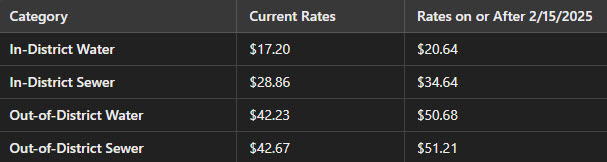
New Water Rates Effective February 15, 2025

The new rates will maintain and support the District’s critical water and wastewater improvements.

What do my new rates pay for?

Granula Activated Carbon (GAC) System – This treament conisists of activated carbon media and underdrain in a closed vessel through which water containing Total Trihalomethanes (TTHMs) is pumped. The activated carbon absorbs the TTHMs onto its surface and removes them from the water. The media physically restrains the TTHMs and will have to be replaced regularly, which adds to the Operations and Maintenance costs.

Caney Creek MUD Board of Directors will hold a Public Meeting on Sunday, January 12, 2025, at 2:00 p.m., at Mike Leebron Park, 716 CR 298, Sargent, TX 77414, to anwer any questions from the public.

Important Notice: Elevated Levels of Trihalomethanes in Caney Creek MUD Water System

The Texas Commission on Environmental Quality (TCEQ) has notified the CANEY CREEK MUD OF MATAGORDA COUNTY water system that the drinking water being supplied to customers had exceeded the Maximum Contaminant Level (MCL) for total trihalomethanes. The U.S. Environmental Protection Agency (U.S. EPA) has established the MCL for total trihalomethanes at 0.080 milligrams per liter (mg/L) based on a locational running annual average (LRAA), and has determined that it is a health concern at levels above the MCL. Analysis of drinking water in your community for total trihalomethanes indicates a compliance value in quarter three 2024 of 0.157 mg/L for DBP2-01 and 0.227 mg/L for DBP2-02.

Trihalomethanes are a group of volatile organic compounds that are formed when chlorine, added to the water during the treatment process for disinfection, reacts with naturally-occurring organic matter in the water.

Some people who drink the water containing trihalomethanes in excess of the MCL over many years may experience problems with their liver, kidney, or central nervous system, and may have an increased risk of getting cancer.

You do not need to use an alternative water supply. However, if you have health concerns, you may want to talk to your doctor to get more information about how this may affect you.

To remedy the TTHM issue Caney Creek MUD is reviewing a proposed Granular Activated Carbon Absorption System as recommended by their engineering consultants, WGA. The district is also working on financing options for this and other necessary projects to maintain a fully operational system.

Please share this information with all the people who may not have received this notice directly (i.e. people in apartments, nursing homes, schools, and businesses). You can do this by posting this notice in a public place or distributing copies by hand or mail.

lf you have any questions regarding this matter you may contact Caney Creek Municipal Utility District at 979-245-0245.

Important Update on Caney Creek MUD Water Quality: Exceedance of Trihalomethane Levels

The Texas Commission on Environmental Quality (TCEQ) has notified the CANEY CREEK MUD OF MATAGORDA COUNTY water system that the drinking water being supplied to customers had exceeded the Maximum Contaminant Level (MCL) for total trihalomethanes. The U.S. Environmental Protection Agency (U.S. EPA) has established the MCL for total trihalomethanes at 0.080 milligrams per liter (mg/L) based on a locational running annual average (LRAA), and has determined that it is a health concern at levels above the MCL. Analysis of drinking water in your community for total trihalomethanes indicates a compliance value in quarter two 2024 of 0.176 mg/L for DBP2-01 and 0.205 mg/L for DBP2-02.

Trihalomethanes are a group of volatile organic compounds that are formed when chlorine, added to the water during the treatment process for disinfection, reacts with naturally-occurring organic matter in the water.

Some people who drink the water containing trihalomethanes in excess of the MCL over many years may experience problems with their liver, kidney, or central nervous system, and may have an increased risk of getting cancer.

You do not need to use an alternative water supply. However, if you have health concerns, you may want to talk to your doctor to get more information about how this may affect you.

To remedy the TTHM issue, Caney Creek MUD is reviewing a proposed Granular Activated Carbon Absorption System as recommended by their engineering consultants, WGA. The district is also working on financing options for this and other necessary projects to maintain a fully operational system.

Please share this information with all the people who may not have received this notice directly (i.e., people in apartments, nursing homes, schools, and businesses). You can do this by posting this notice in a public place or distributing copies by hand or mail.

If you have any questions regarding this matter, you may contact Caney Creek Municipal Utility District at 979-245-0245.

Notice of Public Hearing on Tax Rate – September 11, 2024

As a resident of the Caney Creek Municipal Utility District (MUD), it’s important to stay informed about potential changes that may impact your property taxes. On September 11, 2024, at 9:30 AM, the Caney Creek MUD will hold a public hearing to discuss the proposed tax rate for the 2024 tax year. The meeting will take place at 20305 FM 457, Sargent, Texas 77414.

What You Need to Know About the Proposed Tax Rate

The proposed tax rate for 2024 is set at $0.42422 per $100 of property value, which is a slight decrease from last year’s rate of $0.43690 per $100. This represents a 2.90% reduction in the tax rate. However, due to an increase in the average appraised value of homes within the district—from $303,372 last year to $344,368 this year—the actual taxes paid on an average residence homestead may increase.

Here’s a breakdown of the key figures:

  • Last Year’s Tax Rate: $0.43690 per $100
  • This Year’s Proposed Tax Rate: $0.42422 per $100
  • Percentage Change in Tax Rate: -2.90%
  • Average Residence Homestead Value Last Year: $303,372
  • Average Residence Homestead Value This Year: $344,368
  • Tax on Average Residence Last Year: $800.25
  • Tax on Average Residence This Year (Proposed): $864.26
  • Annual Increase in Taxes on an Average Residence: $64.01 (8.00%)

These changes highlight the importance of understanding not just the tax rate itself, but also how fluctuations in property values can affect your overall tax burden.

What Does This Mean for You?

Your individual taxes may increase, decrease, or stay the same depending on the specific changes in your property’s value compared to other properties in the district. The distribution of the tax burden among property owners is determined by these changes in taxable value.

If the proposed tax rate results in an increase of more than 8% in taxes on the average residence homestead, qualified voters in the district have the right to petition for an election to reduce the tax rate to a voter-approved level. This is in line with changes introduced by the 86th Texas Legislature, which aims to limit the growth of property taxes across the state.

Stay Informed

For more information about your property taxes, including proposed tax rates and details about the public hearing, visit the Texas property tax database at Texas.gov/PropertyTaxes.

Attending the public hearing or reviewing the details on the Texas government website will help you stay informed and engaged with the decisions that affect your taxes. It’s essential to understand how these changes might impact you and what options are available if you wish to contest the proposed rate.

The Caney Creek MUD encourages all residents to participate in this process to ensure that their voices are heard.


For further details, please refer to the official Notice of Public Hearing on Tax Rate issued by the Caney Creek MUD.